CASE STUDY / HEALTHCARE · BRAND LAUNCH · GO-TO-MARKET
Racing the Clock on a Category-Defining Breakthrough

How a full rebrand and launch, built in under a month, helped Insightec claim the market for a new treatment before anyone else could.
CLIENT Insightec (Exablate Neuro)
ROLE Primary Client & Internal Point of Contact / Campaign Lead
DISCIPLINES Brand Strategy · Go-to-Market · Creative Direction · Cross-Functional Orchestration
RESULT Full rebrand and multi-channel launch executed inside a sub-30-day window
01 / The Challenge
Before this project, Parkinson's and essential tremor patients treated with Insightec's incisionless focused ultrasound technology could only have one side of the brain treated per procedure. Treating both sides carried too much risk of trauma and complication, so patients recovered from one side, waited, and — if needed — came back for the other. It wasn't a lack of ambition holding the treatment back. It was physics and safety.
THE BUSINESS
Insightec had been working toward a solution regardless of how hard the problem was.
THE TENSION
The moment that technical constraint was solved, a new one appeared — nobody outside a small clinical circle knew this option existed yet, and the company had only a narrow window to become the answer patients and providers thought of first.
THE QUESTION
How do we build category awareness and demand — for both patients already in the treatment pipeline and new patients just learning this exists — fast enough to own the category before it gets crowded?
02 / The Insight
The breakthrough solved the clinical problem. It didn't solve the market problem.
A new staged bilateral treatment protocol cleared the technical barrier: an incisionless, MR-guided focused ultrasound approach that could now treat both sides of the brain without the trauma the old method carried. That was the hard part, solved. But a genuinely category-defining treatment with no market awareness and no brand presence is still invisible to the patients who need it — and to the providers who'd have to recommend it.
WHAT IT MEANT The constraint wasn't clinical anymore. It was how fast the market could be told, and how credibly.
03 / The Strategy
Rebrand everything, and move before the window closes.
01 / Rebuilt the brand from the ground up
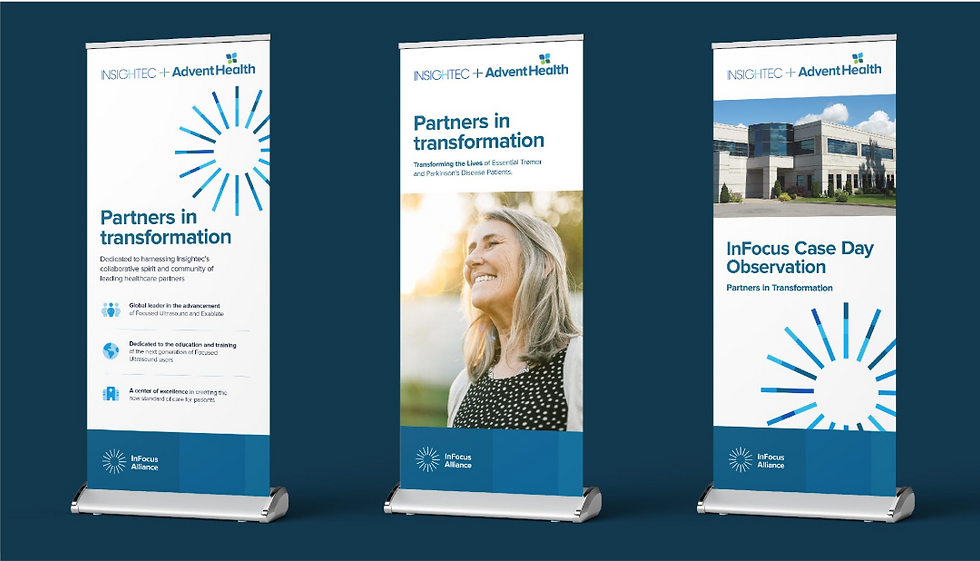
A new look, feel, and tone of voice across the website, landing pages, sales collateral, and hospital/clinical pop-up materials patients would encounter at the point of decision.
03 / Activated organic and paid media in parallel
Reshaped social and paid channels launched alongside the new brand assets, rather than staggered after, to build awareness and demand simultaneously among consumers and providers/distributors.
02 / Prioritized speed as a strategic asset
Launch had to happen almost immediately after the treatment cleared, to capture as much of the category as possible before competitors or default treatment paths hardened.
04 / Built for both audiences at once
Messaging had to work for patients already in the treatment pipeline and for entirely new patients discovering the option for the first time.
04 / The Work
The team had less than a month from being told about the new treatment to getting the first assets live — a compressed, high-intensity sprint to rebuild the website, landing pages, sales collateral, and clinical materials with a new brand identity, then push them out alongside a reshaped paid and organic media presence. Over the following 3–4 months, the campaign was continually refined and optimized based on early performance, before handing off to the internal team to carry forward.



05 / My Role
I was the primary point of contact between the client and internal teams throughout the rebrand and launch — owning the strategy, running the collaboration and review cadence, managing timelines and deliverables, and directing the creative team (designers, developers, photographers, and videographers) to make sure every piece of output routed back to the core strategy and objectives. The team was 7–9 people internally and 6–8 on the client side.
06 / The Impact
A full brand relaunch — website, landing pages, sales collateral, and clinical materials — went from a standing start to live, multi-channel execution in under a month, giving Insightec a fully rebranded market presence at the exact moment the new treatment became available, rather than playing catch-up after competitors had a chance to define the category first.
In the year following this launch window, Insightec's Exablate platform grew from roughly 25,000 to over 30,000 patients treated worldwide, and from 197 to 214 active treatment centers — broader company momentum that this rebrand helped position the bilateral Parkinson's treatment to capture, alongside other factors like new center openings and expanded reimbursement.
07 / The Takeaway
The hardest part of this project wasn't the creative or the timeline — it was recognizing that a genuine medical breakthrough doesn't market itself. Being first to a category only matters if you're also first to tell people about it credibly, which meant treating speed itself as part of the strategy, not just an operational constraint to survive.
NEXT CASE STUDY: Finding Profit in a Process Problem
Brand Strategy · Account Leadership · Process